Monday, 26 July 2021

How to Choose a Mining Pool


The purpose of a bitcoin mining pool is for a group of miners to join together and form a pool. By combining resources from all clients in that pool, they increase the odds of discovering the solution to a given block. When a solution is found to the block, it rewards the newly issued coin to the pool owner. The pool owner then divides the coins between the miners based on their contribution.

• Pooled mining produces a constant revenue of smaller values, whereas solo mining tends to be more erratic and could take years to mine one block.

• Pooled mining can generate a 1–2% higher income (before fees, if any) due to long polling provided by the pools. Solo mining wastes time due to only supporting getwork pull.

When looking for the right mining pool to join, your goal is to find a fair pool that you can trust to provide you with optimal payouts in exchange for your time and energy resources. Though, the pool you choose, statistically, will not increase or decrease your odds. Choosing the right pool can greatly increase your overall earnings.

10 things to consider when choosing a pool

Reputation

Join a group and see what others are saying about any pool before joining it. You will get the best information from miners who have already tried the pool themselves.

Pool Fee’s

Most pool’s charge a fee everytime a block is discovered. For the highest payout over time finding a reliable pool with the lowest fees is crucial. When making your decision, start with considering pools with no fee at all.

Uptime Efficiency

Do the research before committing to a pool. Make sure they have an uptime of 99.5% or higher, check to see if the pool supports backup servers in the case an outage.

Support and Feedback

It’s important that a pool has an open line for support and feedback in case you encounter technical issues or notice any discrepancy in your payout.

Location/Latency


Choose a pool running on a server near you. If your computer takes too long to communicate with the pools server you will lose precious shares. Shares received after a block change, intended for the previous block, are considered stale and not counted.

User Interface Panel

When choosing a pool, be sure to check their statistics page and API tools to determine which provides a better user experience.

Difficulty


A pool with a higher difficulty means they either there are more miners in that pool or they are using high-end mining hardware. This shouldn’t be a concern when picking the right pool, as the difficulty will adjust based on the shares your hardware submits.

Payout Threshold


Always check a pools payout threshold, If the pool has a high payment threshold, low-end mining hardware may not be feasible.

Pool Hashrate


Comparing a pools hashrate to the network hashrate is a good way to measure how often the pool will discover a block. Statistically, this will average out over time and should not affect your overall payout over time.

Payout/Reward Method

Proportional — In this method, rewards are determined based on a division of rounds, the round is measured by the time separating one block discovered by the pool to the next.

CPPSRB — Capped Pay Per Share including Recent Backpay.

DGM — Double Geometric Method. A combination of PPLNS and Geometric reward models that allows operators to absorb some of the variance risks. Operators receive a piece of the reward on short rounds and replace it on longer rounds to normalize payments.

ESMPPS — Equalized Shared Maximum Pay Per Share. Like SMPPS, but equalizes payments justly among all those who have contributed.

POT - Pay On Target. A high variance PPS method, that pays based on the difficulty of work delivered to pool instead of the difficulty of work completed by pool

PPLNS - Pay Per Last N Shares. Similar to proportional, but rather than paying by the number of shares in a round, it instead pays via the last N shares, disregarding the round difficulty and length.

PPLNSG - Pay Per Last N Groups (or shifts). Comparable to PPLNS, but shares are grouped into “shifts” which are paid in whole.

PPS - Pay Per Share. Each submitted share is worth set amount BTC. Since finding a block demands shares on average, a PPS method with 0% fee would be 12.5 BTC divided by . It is risky for pool operators, therefore the fee is highest.

RSMPPS - Recent Shared Maximum Pay Per Share. Like SMPPS, but system proposes to prioritize the most recent miners first.

Score - Score based system: a proportional reward, but weighed by time submitted. Each submitted share is worth more over time since the start of the round. Rewards are calculated proportionally to scores and not to shares.

SMPPS - Shared Maximum Pay Per Share, works the same as Pay Per Share, but is capped to never pay more than the pool receives.

FPPS Full Pay Per Share. Similar to PPSbut not only divide regular block reward but includes some of the transaction fees. It Calculates a standard transaction fee based on a previous round and distributes it by hash power contributions. It increases the miners’ earnings by sharing some of the transaction fees

It’s impossible to find a pool that meets every expectation perfectly, but as you see there are many factors to consider while choosing the right mining pool for you. Ideally, the right pool should offer low/no pool fee’s, a great support team, a server near you, flawless uptime and backup server, a great reputation, and a provides a friendly user experience.


Friday, 23 July 2021

TYPES OF CRYPTO WALLETS


A  crypto wallet is an app for generating, managing, and storing cryptographic keys - your public and private key. You can check your balance, receive, and send funds with a wallet.


Your Mnemonic Phrase


Your mnemonic phrase is a backup of your private key that is used by most wallets. It is a list of random words given to you when creating a wallet, usually 12 or 24. If you break or lose a device with a wallet - no matter if mobile, desktop or hardware wallet - your mnemonic phrase is usually your last line of defense against a loss of funds.


This implies, that any attacker that gets their hands on your recovery phrase will be able to do the same. Therefore, you must protect your mnemonic phrase as well as you would protect your funds themselves.


Important Note: You should write the phrase of words down on paper or save them in any analog format you see fit, but do not save them as a text file on your computer or a screenshot. You don’t want to make it too easy for any potential attacker to steal your money.


The Different Types of Wallets


In this article, we want to give you an overview of what types of wallets there are and help you find the right wallet for you.


Hosted Web Wallets


We can distinguish between hosted and non-hosted web wallets. With hosted web wallets, your keys are stored online by a trusted third party. These parties are mostly exchanges such as Coinbase, Binance or Bittrex. When you create an account with these entities they will create an entry in their internal database linking your account to a set of key pairs for the different coins they have listed.


An advantage with a hosted web wallet is the option to recover your password in case you forget or misplace it. Losing your private keys (together with your mnemonic phrase) leads to a loss of funds in all other cases.


While this may sound reassuring, there are some drawbacks with hosted wallets (also called hot wallets/cloud wallets). Remember: if you don’t control your keys, you don’t control your funds. There is always a third party risk, no matter how trustworthy the party might seem. First, they are a more attractive target for hackers than individuals because their honeypot is much bigger. Second, a sudden change in regulation might not allow them to have you withdraw your funds in a worst-case scenario. It is unlikely, but definitely not impossible. Thirdly, there is always a chance of an entity going bankrupt or stealing money. With the major exchanges like the ones mentioned above this risk seems small, but it does exist. Just ask former Mt. Gox customers. For the reasons above we do advise everybody to store the keys to their funds themselves. This means storing them in a wallet where you have control over your private keys. There is a responsibility that comes with being in charge of the safety of your funds yourself, but enabling you to do this is one of the main motivations for the existence of cryptocurrencies!


You will need to keep some funds on an exchange permanently if you plan to trade often. If you want to do this right, then your level of expertise should be exceeding this article by far anyways.


Non-Hosted Web Wallets


Besides hosted web wallets there is also a range of non-hosted web wallets. The most popular non-hosted web wallet is likely MyEtherWallet, which can store Ether (ETH) and all ERC-20 tokens (tokens that are “living” on the Ethereum blockchain). Those wallets provide an interface to check your funds or create transactions in your web browser, but you have to provide the keys with each login.


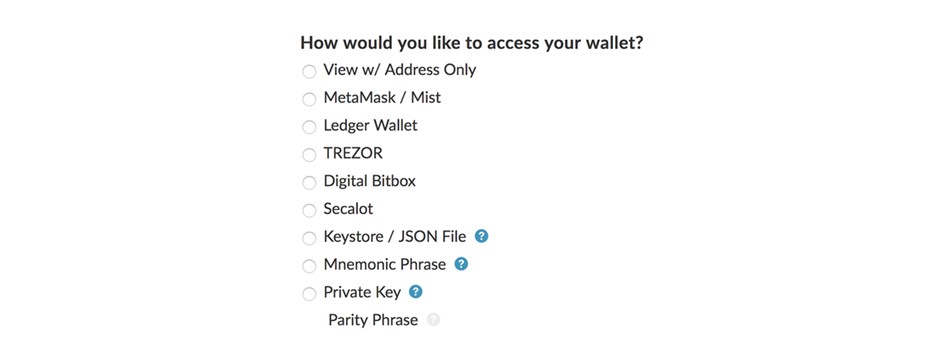
There is a range of options to access your wallet with MyEtherWallet (often abbreviated as MEW). The first option requires your address but only lets you view your funds.


MetaMask is a browser plugin that provides the option to make ETH payments within your browser and the ability to login to MEW. It also provides a function detecting phishing sites and warning you when you are about to open one. The next couple of options, Ledger Wallet, Trezor, Digital Bitbox, and Secalot are hardware wallets. We will get to those later in the article.


Accessing your wallet with a keystore /.json file is possible but not recommended. The file contains your private key and when you create your wallet you have the option to download it. If it gets into the wrong hands they will have access to your funds so saving it on your desktop is not the ideal solution. If you want to use this method, you should encrypt the .json file and store it on a separate device like a USB drive. To use it, connect the drive, decrypt the file, then select the file in your browser and voila. After that, you can disconnect your storage medium of choice again.


The last two options are more or less the same with regards to safety. You can either enter your private key directly or your mnemonic phrase (which yields your private key when hashed) which is both problematic if your machine is compromised.


In conclusion, a non-hosted web wallet is quite convenient and just as secure, as the method, you choose to provide your keys with.


Desktop and Mobile Wallets


If you start off with the question “where are your keys?” the desktop and mobile wallet will give you the same answer: on the device. Phones and tablets are more powerful than ever, the difference between a desktop and a mobile wallet is marginal. It is also arguable whether one is safer than the other.


By now you know the tasks a wallet performs: viewing, receiving and sending. If you want to use crypto for everyday transactions there is almost no way around keeping some funds in a mobile wallet. As mentioned before, when creating your wallet you will get a mnemonic phrase that you should keep safe. Usually, there is a PIN, password or Face-/Touch-ID protection to access the wallet. You should never keep more funds in a mobile wallet than you are willing to lose. It’s the same as with cash: you don’t carry around all your money in a wallet. You withdraw as much as you are comfortable handling in cash and keep the rest in your account (or under the mattress :P).


With desktop and mobile wallets, there is a choice between single- and multi-currency wallets. Those should be rather self-explanatory terms. The former allows you to store one coin, while the latter supports multiple currencies. Some of the more popular examples for desktop include Electrum and Exodus. For mobile, there are Mycelium or Paytomat to name just a few.


If you got your first coins on an exchange, I would recommend you to transfer your funds out of the exchange (hosted web wallet) onto a desktop, paper, or hardware wallet. Send a fraction first to make sure everything works as planned. If your first transaction works then you can send the rest. You are now protected from third-party risk, but have full responsibility for your funds yourself.


Paper Wallets


Grabbing our golden thread again and asking “where are the keys” give you a simple answer with a paper wallet: in your hand! A paper wallet is your public and private key pair printed on paper. Almost every cryptocurrency offers a paper wallet generator. To create a key pair you generally first have to create some entropy (a term for disorder), in other words: you want your keys to be as random as possible. This is mostly done automatically, but sometimes you will find features were you have to randomly move your mouse or hit keys on your keyboard to create randomness.


When printing your paper wallet you shouldn’t use a shared printer like the one in your office. In a best-case scenario, the printer doesn’t even have an internet connection. Printers usually keep a copy of the files they printed last, and an attacker might exploit this. You will end up with something looking like this after printing the wallet.


There is only one thing left to do: send your coins to the public key. After that, you have a perfect gift or long term storage for your coins. The main risk with a paper wallet is you actually losing or destroying the wallet by accident. If you don’t have a mnemonic phrase to recover the private key you are at risk of losing all funds on the wallet by accident. So choose wisely where to store your paper wallet. Print several copies if you feel uncomfortable having only one and store all of them in separate, safe places.


Hardware Wallets


Moving on to everybody’s darling: hardware wallets. With a hardware wallet, your keys are stored on the device in something called the “secure element”. The secure element is a place to store data (here, keys) that cannot be directly accessed by your computer or any other device even when it is connected. Although it does look like a simple USB drive, it can actually do a little more than just providing storage for your keys. To use a hardware wallet you usually have a few options of which interface to use with it. Like MyEtherWallet, a few other wallets offer hardware wallet support. Additionally, you have the native wallet apps provided by the producer. In the case of Ledger, for example, the native App is called Ledger Live.


How Does a Hardware Wallet Work?


The interface generates an address when you want to receive funds. Using this feature is pretty straightforward: if you click the receive button the process runs in the background and the address is displayed for you to share with the sender. If you want to send money the app creates the raw transaction that needs to be signed. The unsigned transaction is now sent to your hardware wallet, where it gets signed with your private key. The signature is then returned to your computer and the complete transaction including the signature broadcasted to the network.


Your private key(s) do not leave the device, so they are not visible to the computer you are using your hardware wallet with at any time. This is why a hardware wallet is considered the most secure way of storing crypto, especially large amounts.


If your device ever breaks, you have your mnemonic phrase as a backup. At the risk of being repetitive: your mnemonic phrase, under all circumstances, must stay private and in a secure location. A copy at a trusted family member or in a bank vault might be a good idea in case of a fire, flooding or a playing dog.


Summary


There are many ways to store your cryptocurrencies. Usually, there is a trade-off between convenience and security. The most important question is: where are the keys? A wallet is only a piece of software, an interface, that helps you perform the basic functions of cryptocurrencies: view your balance, create an address to receive funds, and create transactions to send funds.


With a hosted online wallet you are trusting a third party to handle your keys. You have the option to recover your password if misplaced, but there is always a significant third-party risk. If you don’t control your keys, you don’t control your funds!


With desktop, mobile, paper or hardware wallets you own the keys and nobody but yourself is responsible for keeping them safe. If your device breaks you have a mnemonic/recovery phrase to recover access to your money. The menmonic phrase is as sensible as your private key itself and if it gets in the wrong hands, your money can be stolen. This is should not scare you, but make you cautious.


If you have questions and requests, leave comments below the article.


Wednesday, 14 July 2021

CRYPTO WALLETS


Sometimes there is a little confusion about what a wallet can and cannot do, so we will start with what it can’t. Wallets generally don’t allow you to buy cryptocurrencies; that is what exchanges are for. All exchanges provide you with wallets to store your coins in after you buy them, but wallets usually don’t provide you with an exchange service.

What a Wallet Does

A wallet is a program that has three main functions:

·       Generating, storing and handling your keys and addresses

·       Showing you your balance

·       Creating and signing transactions to send funds


The first function is the main function and main differentiator of all wallets: generating, storing, and handling your keys,having access to your private keys means to be able to spend your money.

Where you store your keys determines the safety of your funds and, at the same time, the convenience of using them. With wallets, there is usually a trade-off between security and convenience: Having some funds on your mobile wallet (your smartphone) makes them easy to spend, but not very secure. Keeping larger amounts of money on a hardware wallet is very secure, but not as convenient when you want to spend it.


A Wallet Acts as a Keychain

We would like to introduce an abstraction, that might help you wrap your head around the concept of your keys and the importance of their safety. Although the term wallet might be more intuitive, the function of a wallet is closer to that of a keychain rather than an actual wallet. To make it crystal clear:


You don’t actually store any cryptocurrency in your wallet. You just store the keys to access them on the blockchain.


The blockchain records the amount of coins associated with a key pair (your identity on the blockchain). It calculates the amount of money the keys have access to based on all the transactions on the blockchain. Remember: the main function of a blockchain is to store all transactions in the correct order. Say you receive 10 ZEN in a first transaction and receive another 10 ZEN later on. It is clear that you, the owner of the key pair, owns 20 ZEN.


To spend your money, you need the private key stored in your wallet. This is why a keychain feels like a good analogy for what a wallet does. If you don’t control your keys, you don’t control your funds. You don’t need to understand how public-key cryptography works in detail in order to use cryptocurrencies, but the concept of your keys, giving you access to your funds, is still important to remember.


Wallets create a layer of abstraction and are becoming more and more user-friendly. Wallets show you your balance, generate an address to receive funds by just clicking “deposit” or “receive”, and provide you with a simple interface to send funds. All you need to do is enter the address that you would like to send money to and the amount you want to transfer. The signing procedure using your private key will happen in the background when you click send.


What if I Lose My Keys?

You don’t have to ask anybody to join the network, and you don’t have to register with a central authority to create a wallet. Being able to do this comes at the cost of you being responsible for the safety of your coins. There is nobody that can help you recover your keys if you lose them. If anybody were able to recover your keys for you, they would also be able to steal your funds. This would eliminate the trustless aspect of blockchains. You may have heard stories about people searching for old hard drives because they have “lost their bitcoins”. More accurately, they lost the keys to access their bitcoin.


But there is a sort of recovery mechanism with many wallets called a mnemonic phrase or backup phrase. A mnemonic phrase usually consists of 12 or 24 words. With these words, you can recover your keys. You receive your mnemonic phrase when you install and set up your wallet. Be sure to write it down on a piece of paper and keep it in a safe place. You should have at least two versions of your backup phrase stored in different locations.


It’s essential to understand that your backup phrase is just as important as your private key itself. If anybody gets their hands on your backup phrase, they can access your money. Saving it as a screenshot or text file on your computer is not a good idea!


Summary

A wallet is a program that helps you manage your keys and create transactions easily. Your wallet looks at the blockchain to determine how much money you own by reviewing the transaction history. To send funds, it writes a transaction and signs it, meaning the wallet encrypts it with your private key.


Monday, 5 July 2021

PoS, PoW, and 11 Other Blockchain Protocols You Didn’t Know About


What is consensus? If broadly defined, a consensus is an agreement that satisfies each of the parties involved. This is the key to democracy and decentralization in general, as well as distributed registry technology in particular. Look at BTC: although Satoshi Nakamoto is his mysterious founder, he (or she!) has no power over the community. Bitcoin, like the blockchain, is completely transparent and open, and each node is equal in this network.

In the narrow sense, we use in cryptography, a consensus is a decision-making procedure. Its goal is to ensure that all network participants agree on their current status after adding new information, a data block or a transaction batch. In other words, the consensus protocol ensures the chain is correct and provides incentives to remain honest participants. This is an important structure to prevent a situation where someone alone controls the entire system, and it ensures everyone abides by the rules of the network.

A short review of a blockchain protocol

A protocol is a set of rules.

It helps:

ensure the viability of online transactions;

eliminate the possibility of double waste;

make sure participants do not cheat.

Blockchain protocol is the amount:

deterministic logical rules;

cryptography and encryption as a basis for security;

social encouragement to support the network protocol.

Let’s review what blockchain protocols exist today, where they are used, and what are their pros and cons.

Disclaimer: the article will be supplemented and edited to provide the most accurate information.

We will start with the mastodons of the industry. Proof of Work (PoW) and Proof of Stake (PoS) are the pioneering protocols that often serve as the prototypes for other modern consensus protocols.


Proof of Work (PoW)

Principle: it is difficult to find a solution, but it is easy to check the result.

Performance: low.

DLT environment: public blockchain.

Completion: probabilistic.

Example of use: Bitcoin, Ethereum, Litecoin.

The bitcoin blockchain is probably the most copied blockchain protocol. Numerous nodes confirm transactions in accordance with the PoW consensus algorithm. To add a new block, the participant must prove he/she has done a certain job. To be precise, it solves a very difficult task of finding a hash that complies with certain rules. The first who was lucky to find the right combination gets the opportunity to add a block to the chain.

As a result, participation in PoW implies the cost of computing resources, but the advantage is that it can be implemented in an environment where participants absolutely do not trust each other. Anyone can join the network, as it is a blockchain, which does not require permission (it’s permissionless). And although the peer-to-peer scalability is high, the transaction rate remains low.

Another problem is the motivation of network members — they usually join in to get rich, and not to maintain justice. Reducing mining fees over time and lower commissions in the future can greatly affect network security.


Proof of Stake (PoS)

Principle: the network trusts the validator, who puts his own resources as a pledge for the ability to create blocks: the larger the share, the higher the probability that the network will allow the creation of a block.

Performance: high.

DLT environment: public / private blockchain.

Completion: probabilistic.

Example of use: NXT, Tezos, soon Ethereum.

The technical feature of PoS is the absence of complex and unnecessary calculations. Instead of competing with others, network participants pledge their crypto actives, such as ether (Ethereum) in Ethereum, and wait for them to be selected to create a new unit.

Here participants are interested in security, as they themselves own the coins of the system. The algorithm selects one validator, based on the share belonging to it. Therefore, if the participant owns a 5% share, then 5% of transactions will be checked. The idea is that the higher the proportion of validator underlying cryptocurrency, the less interest he/she has in manipulating the validation process.

As in the case of the PoW algorithm, the completion of a transaction in PoS is probabilistic. Although transactions are relatively fast compared to transactions on the Bitcoin network, tokens are still required for this. Moreover, skeptics point to the fact that validators with large stakes will be chosen more often and, therefore, will receive even more tokens: the rich are getting richer.


Delegated Proof of Stake (DPoS)

Principle: Participants delegate the production of new blocks to a small and fixed number of elected validators. High competition, but very profitable.

Performance: high.

DLT environment: public/private blockchain.

Completion: probabilistic.

Usage example: EOS, BitShares.

Delegated Proof of Stake (DPoS) enables creating blocks at high speed and process more transactions per second by reducing the number of validators. During the voting, coin holders choose validators to form the blocks. The weight of each vote is defined by the sum of the assets of the voter. Coin holders can vote for validators at any time. This determines the high flexibility of the network: if the majority of performers fail, the community will instantly vote to replace them.

The production of new blocks occurs every 1–2 seconds. This protocol is faster and fairer compared to PoS since the “delegated” validator later shares tokens with its voters. Although, the confirmation of the finished blocks still lies on the shoulders of all the other members of the network.


Proof of Activity (PoA)

Principle: a hybrid of PoW and PoS.

Performance: low.

DLT environment: public.

Completion: probabilistic.

Usage example: Decred.

Proof-of-Activity (PoA) combines the PoW and PoS protocols, which means that participants can mine or lay down a share to validate the blocks. So, the PoA protocol provides a balance between miners and ordinary members of the network.


Proof-of-Location (PoL)

Principle: beacons are used to notice a node in a synchronized state, and then to mark its presence with a temporary stamp.

Performance: average.

DLT environment: public.

Completion: immediate.

Usage example: FOAM, Platin.

Proof-of-Location (PoL) allows users to secure a specific GPS location and thus authenticate themselves on the network. Interestingly, this blockchain protocol relies on BFT beacons, which record geolocation and time markers in the blockchain, which prevents disruptions and fraud in the system.


Proof-of-Importance (PoI)

Principle: like PoS, but with additional properties that affect your ranking.

Performance: high.

DLT environment: public.

Completion: probabilistic.

Usage example: NEM.

The algorithm acts almost like PoS, but includes three components:

the number of tokens in the account;

account operations activity;

the time spent by the account holder on the network.

The first parameter plays an essential role in the rating for verifying transactions; the second and third parameters just help to establish the “value” of the account. The smaller the sum of tokens, the stronger the influence of other parameters.

Consequently, an account that lays hundreds of thousands of tokens can increase the coefficient of importance by almost 3 times due to its activity and constant presence in the network. On the other hand, it does not matter for those who own hundreds of millions of tokens.


Proof-of-Elapsed-Time (PoET)

Principle: blocks are created in a trusted environment with equal periods.

Performance: average.

DLT environment: private blockchain, with and without permissions.

Completion: probabilistic.

Usage example: Intel.

Intel did not lag behind and developed its own blockchain protocol called IntelLedger.

This system is similar to Proof of Work but utilizes less electricity. Instead of participants solving a cryptographic puzzle, the algorithm works in a Trusted Execution Environment (TEE) environment, such as Intel Software Guard Extensions (SGX). The PoET protocol guarantees that the blocks are generated randomly and without any necessary efforts.


Proof of authority (PoA)

Principle: semi-centralized blockchain for banks and insurance companies

Performance: high

DLT environment: Public, private or consortium.

Completion: probabilistic

Example of use: Kovan, Rinkeby, Giveth, TomoChain, Rublix, Swarm City, Colony, Go Chain.

Similar to PoS and DPoS, in PoA validators secure the blockchain and are able to produce new blocks. New blocks on the blockchain are created only when a supermajority is reached by the validators.

By identifying pre-selected authorities, PoA consensus becomes centralized. Therefore, it’s suited for private blockchains and consortiums, such as a group of banks or insurance companies for better scalability. The identities of all validators are public and verifiable by any third party. Having their identity at stake, validators act in the best interest of the network.

Proof of Burn (PoB)

Principle: burning a mined PoW cryptocurrencies in exchange for mining privileges or the coins/tokens of an alternative currency

Performance: medium

DLT environment: Public

Example of use: Slimcoin and Counterparty

Miners send coins to an unspendable address (an eater address) in such a way burning them (coins can no longer be accessed and spent again). As PoB transactions are recorded on the blockchain, there’s undeniable proof that the coins are inaccessible, and the user is rewarded.

The idea is that a user demonstrates a willingness to undergo a short-term loss for long-term investment — a lifetime privilege to mine on the system. The more coins a user burns, the higher the chance to mine the next block.


Proof of Capacity (PoC)

Principle: The amount of “work” a miner will perform depends on the amount of free disk space to devote to the plotting process.

Performance: high and efficient

DLT environment: public

Example of use: Burstcoin and Bitcoin Ore

PoC is similar to PoW with a considerable difference — in PoC, rather than doing a large amount of work to verify each block, the work is done in advance in the process called “plotting”; the results from this process are used later to verify each block.

Plotting is the process of producing special files called “plot files” which store a large number of precomputed hashes. The shortest solution to the mining algorithm grants the rights to mine the next block. PoC is efficient, cheap, and distributed.

Proof-of-Brain (PoB)


Principle: the protocol enables smart, a social currency for publishers and content businesses

Performance: fast and efficient

DLT environment: public

Example of use: Steemit

PoB is a scalable blockchain protocol for openly accessible and immutable content accompanying a fast and fee-less digital token — STEEM — which helps people earn money by using their brains thus the name. STEEM is a means for creating unceasingly growing communities with members adding value through the built-in rewards structure.

PoB is a public publishing platform called Steemit from which any Internet application can share data in such a way rewarding those who contributed this valuable content.


Proof-of-Physical-Address (PoPA)

Principle: identity verification DApp

Performance: high

DLT environment: private

Example of use: ConsenSys and POA Network

Proof of Physical Address (PoPA) is a DApp which connects a real-life physical element with blockchain technology. This helps in verifying an individual’s identity. PoPA connects a person’s physical address with a wallet address in which they control the respective private key.

Every time a user verifies his/her card in the DApp, the PoPA protocol refreshes its own record and calls the ERC780 congenial contract to store the user/address connection.


Proof-of-concept (PoC)

Principle: demonstrates the feasibility of any blockchain project

Performance: unknown

DLT environment: private

Example of use: unknown

A Proof of Concept (POC) can be used in any field such including Voting trackers, Record storage, Legal documents, etc. A POC can either be a prototype without any supporting code or a Minimum Viable Product (MVP) with a base feature set. A POC is a model used for an internal organization to have a better understanding of a particular project.

Consensus protocols are an integral part of distributed systems. They help to achieve justice, to avoid system failures when one of the participants — the node — fails. Secondly, a decentralized environment requires solutions which will help move forward and change the general state, even in an environment where no one trusts anyone. Certain rules help to reach “consensus”.

We reviewed the most popular protocols which are already used in dozens of projects. Still, there are also Cross-resiliency (XFT), Paxos, Sieve, Raft protocol, Byzantine resiliency (BFT), direct acyclic graphs (DAG), and even non-blockchains conducted through a mental experiment which we’ll describe later.

If you have questions and requests (for instance, to review a certain blockchain protocol), leave comments below the article.


Tuesday, 29 June 2021

Supernode Proof of Stake Consensus Complete Guide


Supernode Proof of Stake Consensus Complete Guide


1. Basic introduction

Supernode Proof of Stake (SPoS) is a blockchain consensus mechanism designed by Sunny King, the creator of Proof of Stake (PoS) consensus, in June 2018. It is an extension to many core concepts of PoS, including Stake as Power, decentralization, high scalability and more. Compared to the new generation of mechanisms inspired by PoS, such as Casper, hybrid PoS, and DPoS, which is sometimes not considered as PoS, SPoS is a true and faithful continuation to the original PoS fundamentals.

Released in 2013, PoS was designed to resolve several key issues associated with Bitcoin’s Proof of Work (PoW) consensus mechanism, including energy inefficiency, centralization of mining pools and lack of scalability. Since its creation, many cryptocurrencies have been inspired by PoS and adopted the algorithm, such as Dash, Cardano, and Sunny King’s own creation Peercoin.

However, PoS consensus mechanism carries certain shortcomings, and is unable to meet the requirements of the current blockchain field for the development and application of a single public chain platform. On December 31th 2016, therefore, Sunny King started a new thing, this thing will change the history again.

In November 2018, Sunny King launched the first native blockchain platform V SYSTEMS based on his SPoS consensus mechanism. The project aims to deliver a blockchain database and cloud platform, with the vision to bring forward a new economic era consisting of hundreds of millions of blockchain applications.

2. Summary of PoS

Since SPoS is an extension to PoS’ original ideologies, it is crucial to learn the key technical features of PoS before fully understanding the concept of SPoS.

1. Almost no energy consumption

PoS does not rely on electricity nor computational power as the basis for block validation, thereby consuming almost no energy.

2. Unlimited level of scalability

As the validation process is not restricted by hardware or electricity constraints, in theory, the blockchain carries an unlimited level of scalability. This paves the way for large scale blockchain technology applications.

3. Coin utility determines coin value

The coin value is not reliant on the intrinsic value nor the equivalence of other types of goods (e.g. the cost of mining). Instead, the coin value is determined by the coin utility.

4. Stake is power

Block validation and rewards are both based upon stake.

5. Decentralization

Without mining pools, there will be no giant and centralized institutions to dominate the blockchain.

6. Random block production

PoS uses the design of random block production, and only the average block interval can be observed.


3. Criticisms for PoS

SPoS is designed to tackle the issues of PoS. It is therefore also important to learn the key criticisms faced by PoS in order to fully understand the rationale behind SPoS.

1. Nothing-at-stake

Nothing-at-stake is one of the major concerns on PoS. The argument suggests that because block validation does not involve computational power or energy consumption, coin minters will try to mint on all block trees in order to prevent himself from not minting on the winning chain, therefore avoiding any potential loss and maximizing the gain.

2. Stake liquidity limited by coin age

PoS imposes many restrictions on the movement of stake after participating in coin minting. On a technical level, this design prevents frequent attacks (i.e. the holder of the coin can “vote more than once” and one stake gains multiple benefits).

From the perspective of PoS, one stake should not be allowed to claim multiple minting rights. However, one might be able to take advantage of stake liquidity and attempt to quickly move the stake around to claim more minting rights than it should. This type of attack is referred to as “busy contention attack”.

Even though the restrictions on movement may be of good reasons from a technical point of view, economically it is a barrier of entry for users to participate in minting. Coin holders are often concerned on how long their coins will be locked for the minting process.

Under SPoS, however, the number of stakes participating in minting is directly related to the level of security for the mechanism, similar to how computing power determines bitcoin security level. In this sense, not putting any restrictions on movement of stake is in fact beneficial to network security.

3. Coin age cannot accurately reflect contribution

As a proof of the stake value in minting opportunity, coin age shows a high level of stability and a wide range of advantages.

However, since it is a transaction-based measurement, the computational complexity is correlated with the number of transactions executed in a given time. Also, coin age is not an accurate indicator of the stake owner’s contribution to the community.

4. Minting security

Since PoS requires minter to sign the block, the private key must remain online, which poses a potential huge risk to the minter.

5. Inability to support large scale adoption

Under PoS, not all nodes receive enough incentives to undergo hardware upgrade. Moreover, if a random block production is adopted like in Bitcoin or other PoS blockchain, the actual production interval may sometimes far exceed the average time.

These issues create a huge concern for the efficiency of the blockchain, as systems usually prefer a constant response time over a random one.

4. Evolution from PoS to SPoS

1. Nothing-at-stake

The concern on nothing-at-stake is in fact unnecessary, as it ignores the fact that when a person owns a certain amount of stake in the ecosystem, the person is motivated to maximize the interest of the community instead of initiating attacks.

Coin owners who seek to maximize profits use the exchange value of the coin as a measurement of the coin value. Minting on all branches of block tree will be contradictory to his self interest, as it is considered a type of attack and the action will lead to a drop in the exchange value.

Considering the negative impact on the coin value, the potential loss on not minting on all branches is far less than the potential loss on coin value. Rational coin owners will always choose to uphold the protocol and ideologies of the consensus mechanism in order to maximize the interest.

In fact, the issue of nothing-at-stake has yet to be observed in a real scenario.

2. Stake liquidity

With a high level of stake liquidity, minters can spend or transfer their stake at any time. Coin leasers can also withdraw their lease, spend, or transfer their stake at any moment. This freedom of movement helps safeguard the blockchain. Take an extreme example of when supernodes are under attack — under SPoS mechanism, a coin holder can immediately withdraw the lease and switch to a secure backup supernode. This will render the attack meaningless, and also make it difficult to attack the blockchain as a whole, as in theory the hacker will have to attack an unlimited amount of supernodes.

Although there is a concern of busy contention attacks due to stake liquidity as mentioned in previous section, SPoS is well adapt to counter the situation. The mechanism introduces a unique measurement of account balance, similar to the accumulative average measurement during minting contention. The idea is that the stake must remain in the account for a period of time and wait for the metric to return to full. This design helps eliminate the concerns on frequent attacks.

3. Coin age

A minting balance mechanism is introduced for coin age measurement in the SPoS mechanism. The idea is that when a stake is withdrawn from the supernode, the total amount of stake on the supernode is immediately reduced. However, when a stake is leased to the supernode, the total amount of stake on the supernode is not immediately increased.

Whether the supernode wins the minting right depends on the minting balance. This minting balance, on the other hand, is dependent on whether the leased stake has been placed for a sufficient period of time. Yet, the length of the stake placement time and minting rewards are not correlated.

4. Minting security

To raise the level of security, SPoS mechanism separates the roles of minter and spender. That is, the private key of the coin holder can be different from the private key of the coin minter. With this design, all private keys of the stake can be put in offline storage.

This naturally allows the emergence of minting pools — the supernodes in SPoS. It is a similar concept to mining pools in Bitcoin.

Sunny King has also introduced a balanced minting right to prevent centralization of supernodes. This will be further explored in later sections.

5. Supporting large scale decentralized applications

The introduction of supernodes provides sufficient incentives to ensure that the supernodes continuously upgrade the hardware to support the blockchain expansion.

Also, the fixed block production sequence and production interval allows the supernode local clock to synchronize with the Internet time protocol. This ensures a high efficiency of block production as well as improves the security and predictability.

5. Technical and economical features of SPoS

Key technical features of SPoS:

1. Fixed block production sequence and constant block interval

2. Cold minting

3. Supernodes

Key economical features of SPoS:

1. Both stake owners and supernodes receive incentives for block production

Minting rewards are shared by supernodes and stake owners. The reward sharing ratio is determined by the supernode. Currently, there are 15 supernodes running on the V SYSTEMS mainnet. Coin holders (stake owners) can lease their coins to the supernode in order to earn the minting rewards. Each supernode takes turn to generate blocks in a minute, with each block bringing 36 VSYS Coins as rewards.

Based on the current number of supernodes, each supernode will generate 51,840 VSYS coins per day. After deducting around 20% of the reward for hardware upgrade and other operational costs, the remaining 80% will be proportionately distributed to coin holders who leased their coins to the supernode.

2. Minting right and minting rewards are distributed in a fair manner, thus eliminating the risk of minting pool centralization

Equal minting right for each minting slot gives supernodes an equal standing and minting output. This is contrary to the design of Bitcoin, where no built-in mechanism is put in place to prevent the domination of mining pools. SPoS eliminates this major barrier that hinders the goal of decentralization.

The equal minting right of minting slot plays an important role in the minting economy. Supernodes form a market of minting pools. The minting market will then form an interest rate for leasing. Since stake owners have a reasonable preference to lease to a supernode paying higher lease rate, and the additional lease to a high paying supernode will lower its lease rate due to the constant minting output of the supernode, an equilibrium exists as a built-in force to equalize the lease rates of supernodes.

6. Advancements of SPoS

1.      Superior version of PoS, following the stake-as-power philosophy

2.     The only everyone can easy minting and easy out consensus.

3.     Performance-oriented, support large scale decentralized applications

4.     Most resistant consensus mechanism to 51% attack

5.     Highly secure of minting progress for all ecosystem participants

6.     Decentralized supernodes

7.     Simplify the consensus using a mathematical approach just like bitcoin & PoW did

What Is The Metaverse?

  The Metaverse is the sum of all shared, persistent virtual spaces. It is the totality of all the digital and virtual worlds as well as d...